
4 KiB
| title | slug | date | tags | |
|---|---|---|---|---|
| Amateur radio licence | /amateur-radio-licence/ | 2026-03-12 |
|
In February I bit the bullet and booked the exam for the UK Amateur Radio Licence (Foundation Level).
Having the exam in the calendar helped me concentrate and remain focused, as my learning style is naturally quite slow and meandering. I really wanted to earn my licence so that I could get on the air and begin to advance my practical knowledge.
I used the official Radio Society of Great Britain (RSGB) textbook and a simplified syllabus from Essex Ham Train.
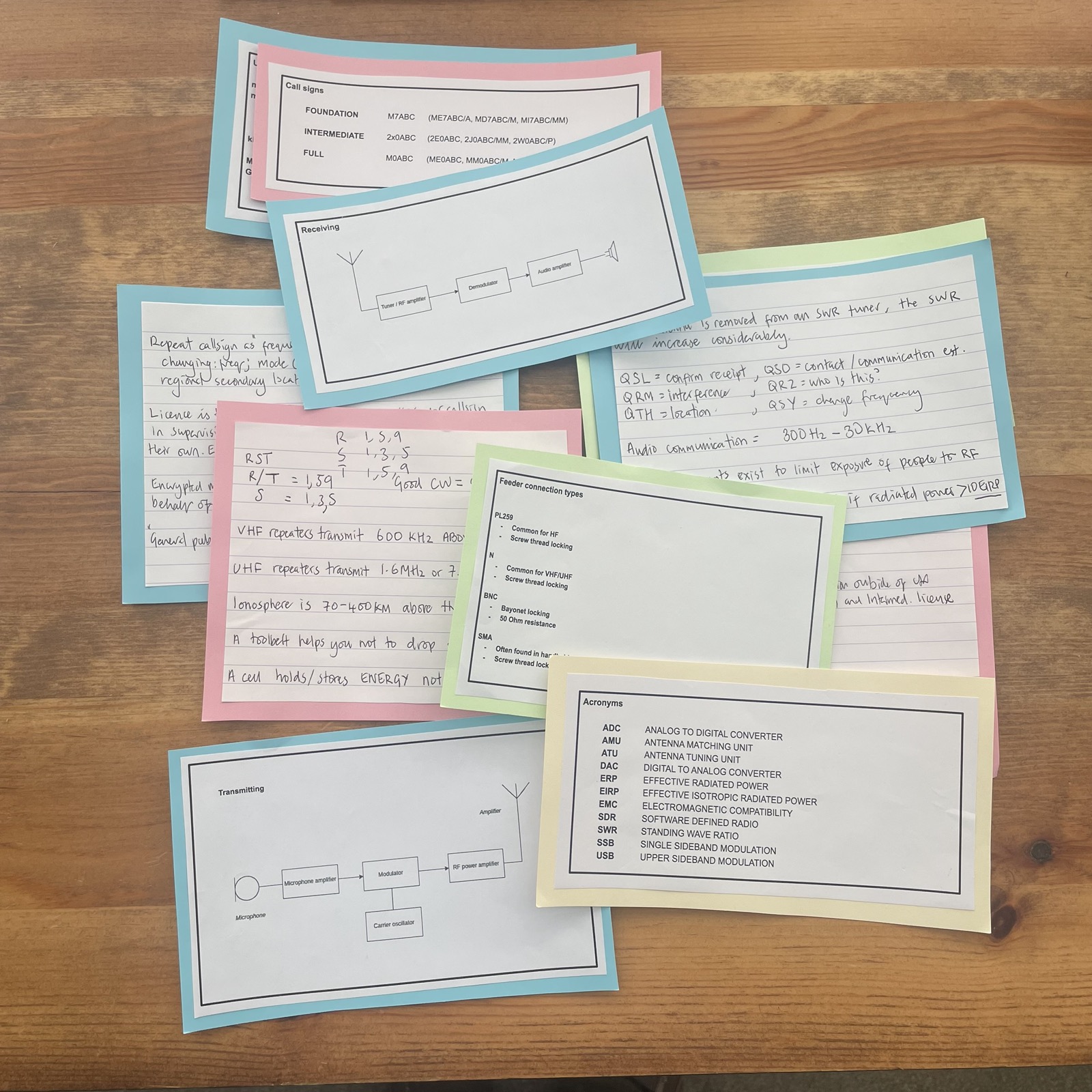
In the mocks, I was averaging an 80% pass rate but in the exam itself I did particularly well and scored 92%, getting only two questions wrong (one of which didn't come up at all in the training materials). I completed the exam remotely but there was an RSGB invigilator observing my screen and environment to check I wasn't cheating! (Thank you Malcolm, G3ZNU.)
Having received my certificate I was able to apply to Ofcom for my callsign. I chose M7SYO. The first two characters are mandatory and denote my qualification level ("Foundation") and the last three are your personal choice, based on what is available. Luckily I was able to choose letters reflecting "Systems Obscure". When appropriate to do so, I can add "E" as my regional secondary locator to indicate that I am operating from England (e.g. ME7SYO).
The Foundation level is pretty generous given that it is the entry-level. I can transmit up to 25W and am permitted to use most of the amateur bands (10m, 12m, 15m, 17m, 20m, 30m, 40m, 80m) at HF, apart from 60m, and many of the VHF/UHF bands.
I am lucky that my uncle, Greg, is an experienced amateur operator and secretary of his local amateur radio club in Macclesfield. He has been helping me with my practical knowledge and advising on what gear to start with. For now, I have ordered the affordable and well-regarded Baofeng UV-5RM Plus handheld along with a NA-771 antenna. This will enable me to connect to repeaters and hopefully make my first QSOs (contacts). I also plan to construct some home-made antennas that I can attach to the handheld and experiment with.
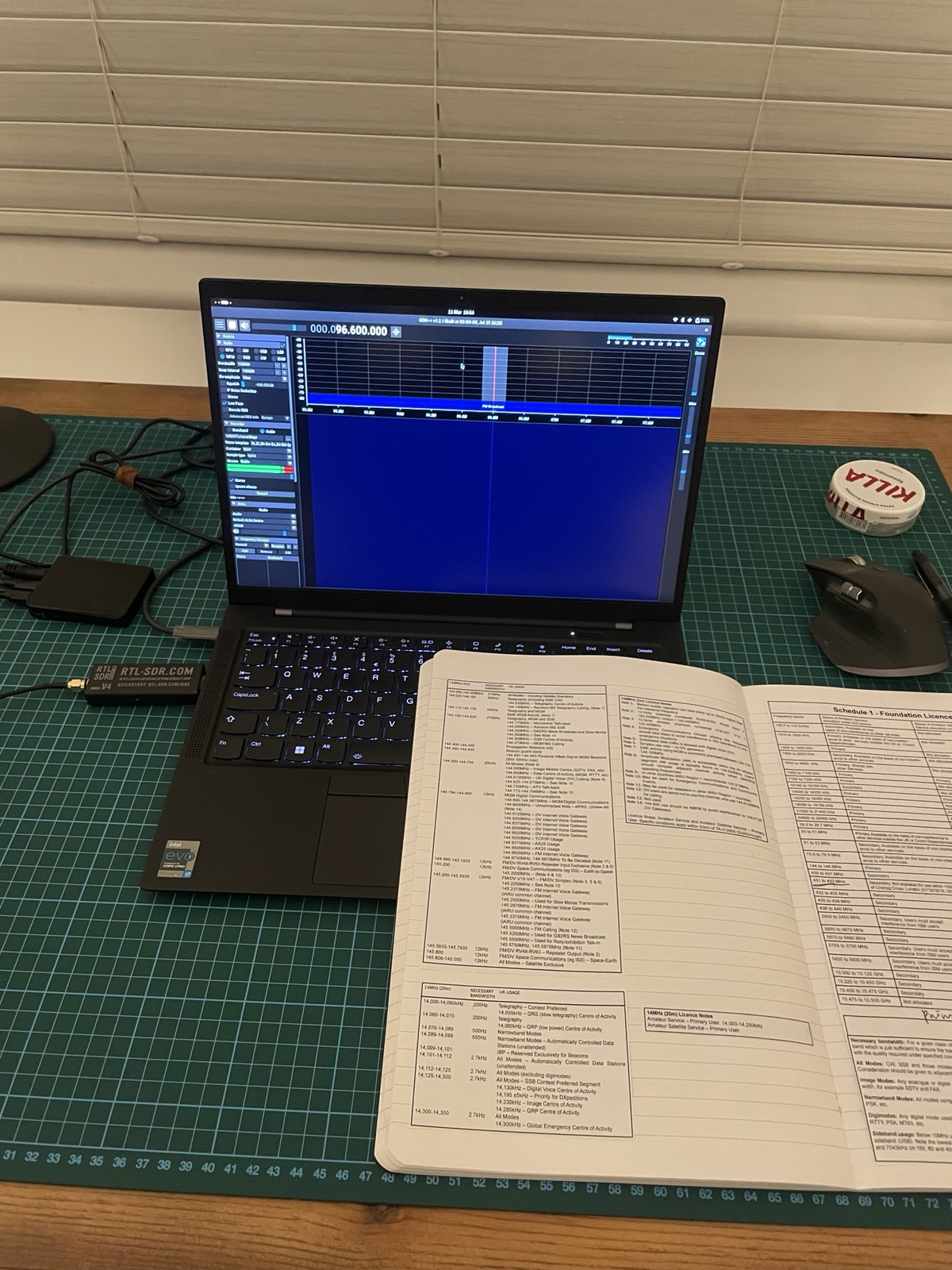
As I'm still waiting for the radio to arrive, I am currently limited to monitoring transmissions via my SDR (RTL-SDR v.4). I've been able to pick up some Morse conversations and a faint read of the strange - possibly Iranian - number station that is currently perplexing the amateur community.
In order to access the HF band and reach contacts further afield by exploiting ionospheric propagation, I will need a better and more powerful tranceiver. I am looking into getting a second-hand portable Yaesu through one of Greg's contacts. My plan is to drive or cycle to good spots locally and work in the field. I also eventually want to communicate over CW using Morse code and experiment with some radio astronomy. The possibilities are pretty limitless with this hobby!
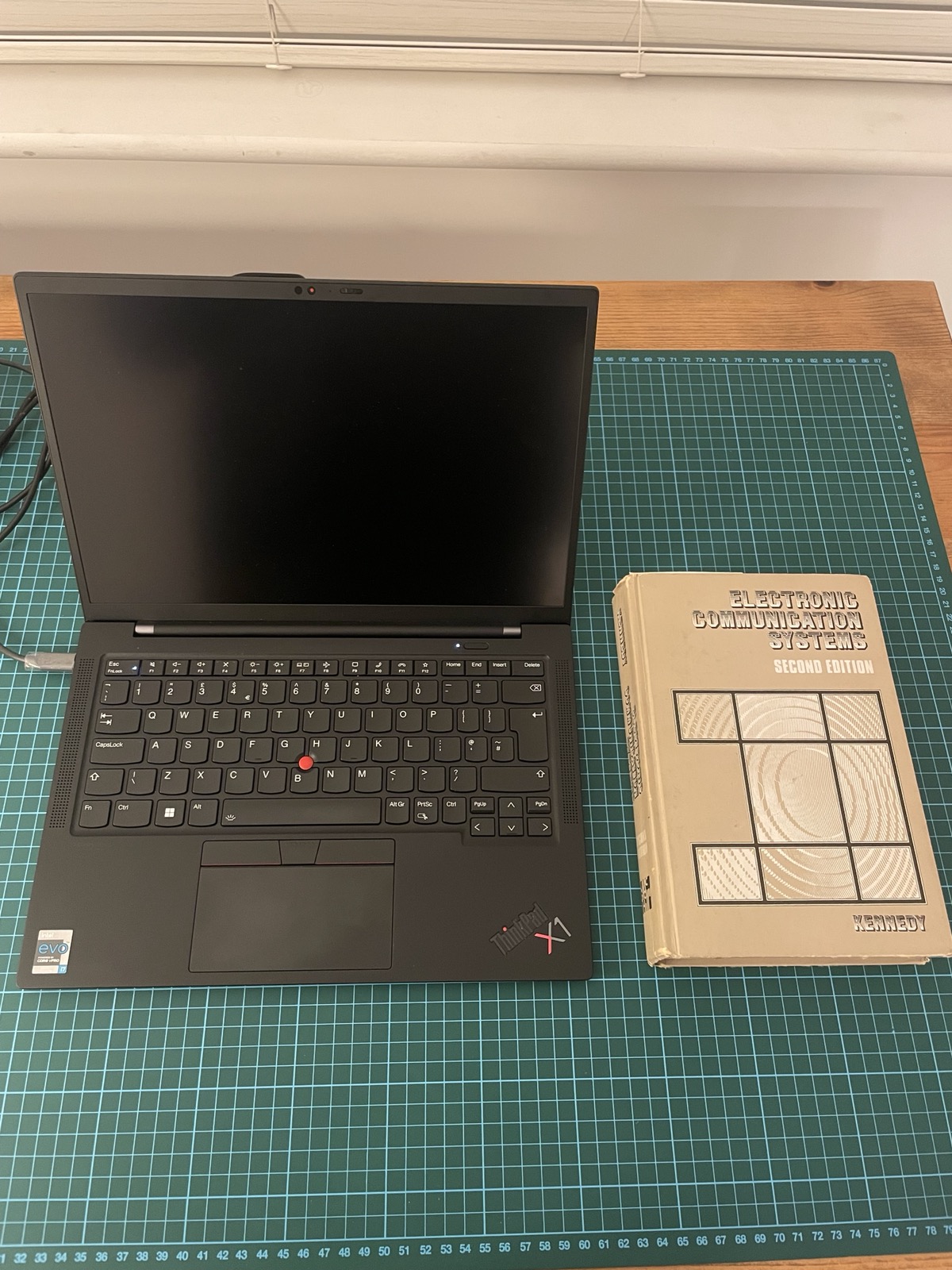
To facilitate my field work I wanted a small and robust laptop so I bought a second hand ThinkPad X1 Carbon (Gen.9). It's very sleek compared to my old T15 and the i7 processor really makes a difference. I'm running Fedora Workstation for a hassle-free and easily maintainable Linux environment.
Finally, I joined the RSGB. This gives me access to lots of useful radio resources, free access to the National Radio Center at Bletchley Park, and the print edition of the monthly RadCom magazine which is a really good read.
Once I start transmitting I will report here on my progress...